
- 전체
- 물리
- 천체물리 - 우주(과학)
- 정보 (및 수학)
- 화학
- 생물 및 의학 (건강)
- 전기전자
- 지구과학 and 환경
- 사회과학
- 기계
- ITFIND 주간 기술 동향
- 월간 ICT 동향
- 인문학(과학)
[출처] http://www.sciencedaily.com/releases/2014/10/141031145920.htm
Iron-based superconductor simulations spin out new possibilities on titan
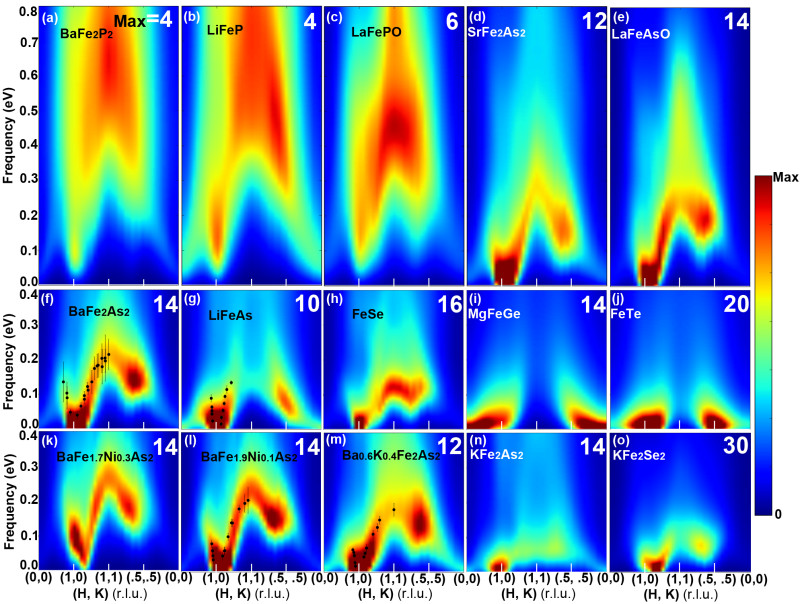
Researchers studying iron-based superconductors are combining novel electronic structure algorithms with the high-performance computing power of the Department of Energy's Titan supercomputer at Oak Ridge National Laboratory to predict spin dynamics, or the ways electrons orient and correlate their spins in a material. Because researchers have suggested that spin dynamics create the conditions needed for superconductivity, this approach could expedite the search for new or modified materials that conduct electricity with little or no resistance at higher temperatures, unlike current commercial superconductors, which must be expensively cooled to exhibit superconducting properties.
In a Nature Physics paper published in October, Zhiping Yin, Kristjan Haule, and Gabriel Kotliar of Rutgers University compute the dynamic spin structure factors -- or the measure of how the spins of electrons align relative to each other at a given distance at different times -- of 15 iron-based materials, including several high-temperature superconductors, in unprecedented detail.
"Our computational results are in good agreement with experimental results for experiments that have been performed, and we have several predictions for compounds that have not yet been measured," Kotliar said. "Once we validate the theory that our computational models are based on with experiments, then we can investigate materials computationally that are not being studied experimentally."
Computation offers a way for researchers to better understand spin dynamics and other material properties under many conditions, such as temperature change, rather than the singular condition present during a given experiment. Computation also allows researchers to simulate many of these materials at once, and the number of potential materials to explore rapidly increases as scientists introduce modifications to improve performance.
With the computational power at hand on the 27-petaflop Titan system managed by the Oak Ridge Leadership Computing Facility, the team was able to compare and contrast spin dynamics for all 15 materials simulated to identify tell-tale superconducting properties.
"By comparing simulations and experiments, we learned about which type of spin fluctuations actually promote superconductivity and which ones do not," Kotliar said. In their model, the team used a technique called Dynamical Mean Field Theory to reduce the vast number of interactions involving electrons in a unit cell (the most detailed slice of material simulated) and averaged these interactions in a mean field environment across the rest of the solid. The team used the Monte Carlo method to statistically select the best solutions for these techniques, achieving a new level of predictive accuracy for spin dynamics in these kinds of materials.
"We find these complex problems, as in superconductors, where you have to solve many degrees of freedom or a large number of variables, require supercomputing rather than computing on smaller clusters," Haule said. "Our algorithms are designed to work very efficiently on Titan's massively parallel architecture."
Using 20 million processor-hours on Titan, the team also discovered through simulation a new superconducting state, or electron pairing, found in the lithium-iron-arsenic compound, LiFeAs, that is consistent with experimental results.
In the future, they plan to simulate spin dynamics in other classes of superconductors and in non-superconducting materials that are exceptionally difficult to study experimentally, such as radioactive materials.


"Using computation as a substitute for experiment is an important step forward for designing new materials," Kotliar said. "The next time someone comes to us with potential materials for an application and asks, 'Should I work on this?' we hope to simulate that material through computation to select the most promising ones."
Story Source:
The above story is based on materials provided by Oak Ridge National Laboratory. Note: Materials may be edited for content and length.
Cite This Page:
광고 클릭에서 발생하는 수익금은 모두 웹사이트 서버의 유지 및 관리, 그리고 기술 콘텐츠 향상을 위해 쓰여집니다.
댓글 0
| 번호 | 제목 | 글쓴이 | 날짜 | 조회 수 |
|---|---|---|---|---|
| » |
Iron-based superconductor simulations spin out new possibilities on titan
 | 졸리운_곰 | 2014.11.04 | 299 |
| 37 |
NASA, 차세대 우주선 '오리온' 공개…12월 시험비행 예정
| 졸리운_곰 | 2014.10.31 | 408 |
| 36 |
슈레딩거 고양이 양자 이론 실험
| 졸리운_곰 | 2014.10.14 | 801 |
| 35 |
최초의 광자 라우터
| 졸리운_곰 | 2014.07.21 | 476 |
| 34 |
힉스 입자보다 더 희귀한 프로세스 검출
| 졸리운_곰 | 2014.07.21 | 391 |
| 33 |
한방향으로만 빛을 진행하게 하는 새로운 메타 물질
| 가을의곰 | 2014.07.07 | 511 |
| 32 |
특이한 입자 연구
| 가을의곰 | 2014.07.07 | 349 |
| 31 |
중력파를 증명하기 위한 중성자별 정밀측정
| 가을의곰 | 2014.07.07 | 457 |
| 30 |
짧은 수명의 전자 자유도
| 가을의곰 | 2014.07.02 | 1363 |
| 29 |
죽은 별의 회전을 늦추는 끈적이는 암흑물질
| 졸리운_곰 | 2014.06.30 | 546 |
| 28 |
오류없는 양자 컴퓨터의 실현
| 졸리운_곰 | 2014.06.28 | 523 |
| 27 |
물리학의 통합을 암시하는 초유체 시공
| 졸리운_곰 | 2014.06.28 | 488 |
| 26 |
개정된 중력 이론 제안
| 졸리운_곰 | 2014.06.28 | 546 |
| 25 | 모든 사람이 과학자가 될 수 있다. | 졸리운_곰 | 2014.06.28 | 388 |
| 24 |
전자 저장 고리
| 졸리운_곰 | 2014.06.07 | 353 |
| 23 |
양자 뒤엉킴에 대한 중력 효과
| 졸리운_곰 | 2014.06.07 | 438 |
| 22 |
칩 상에 설치된 105-비트 광 메모리
| 졸리운_곰 | 2014.06.07 | 552 |
| 21 |
아직도 불확실한 중력파의 증거
| 졸리운_곰 | 2014.06.07 | 380 |
| 20 |
지구와 달 사이의 광대역 레이저 통신
| 졸리운_곰 | 2014.05.31 | 512 |
| 19 |
양자 상호작용의 이해
| 졸리운_곰 | 2014.05.25 | 563 |