
- 전체
- 물리
- 천체물리 - 우주(과학)
- 정보 (및 수학)
- 화학
- 생물 및 의학 (건강)
- 전기전자
- 지구과학 and 환경
- 사회과학
- 기계
- ITFIND 주간 기술 동향
- 월간 ICT 동향
- 인문학(과학)
전기전자 Breakthrough in molecular electronics paves way for new generation of DNA-based computer circuits
2014.11.04 15:53
[출처] http://www.sciencedaily.com/releases/2014/10/141026195244.htm
Breakthrough in molecular electronics paves way for new generation of DNA-based computer circuits
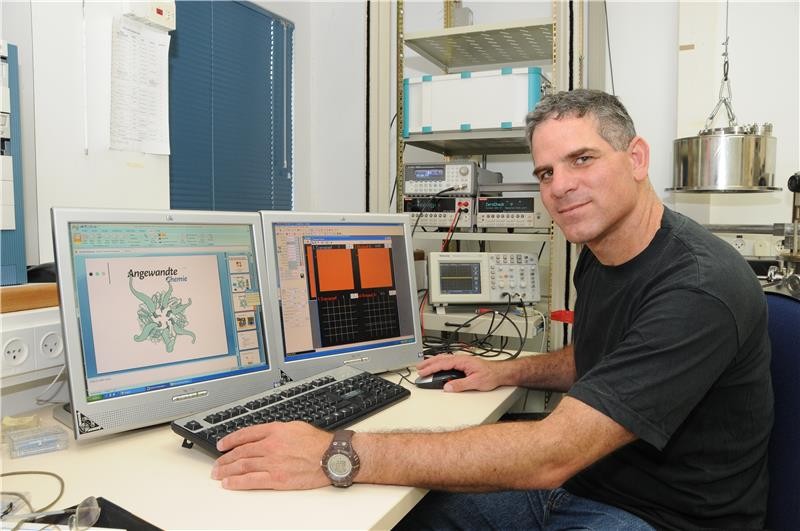
In a paper published today in Nature Nanotechnology, an international group of scientists announced the most significant breakthrough in a decade toward developing DNA-based electrical circuits.
The central technological revolution of the 20th century was the development of computers, leading to the communication and Internet era. The main measure of this evolution is miniaturization: making our machines smaller. A computer with the memory of the average laptop today was the size of a tennis court in the 1970s.
Yet while scientists made great strides in reducing of the size of individual computer components through microelectronics, they have been less successful at reducing the distance between transistors, the main element of our computers. These spaces between transistors have been much more challenging and extremely expensive to miniaturize -- an obstacle that limits the future development of computers.
Molecular electronics, which uses molecules as building blocks for the fabrication of electronic components, was seen as the ultimate solution to the miniaturization challenge. However, to date, no one has actually been able to make complex electrical circuits using molecules. The only known molecules that can be pre-designed to self-assemble into complex miniature circuits, which could in turn be used in computers, are DNA molecules. Nevertheless, so far no one has been able to demonstrate reliably and quantitatively the flow of electrical current through long DNA molecules.
Now, an international group led by Prof. Danny Porath of the Hebrew University of Jerusalem reports reproducible and quantitative measurements of electricity flow through long molecules made of four DNA strands, signaling a significant breakthrough towards the development of DNA-based electrical circuits. The research, which could re-ignite interest in the use of DNA-based wires and devices in the development of programmable circuits, appears in the journal Nature Nanotechnology under the title "Long-range charge transport in single G-quadruplex DNA molecules."
Prof. Porath is affiliated with the Hebrew University's Institute of Chemistry and its Center for Nanoscience and Nanotechnology. The molecules were produced by the group of Alexander Kotlyar from Tel Aviv University, who has been collaborating with Porath for 15 years. The measurements were performed mainly by Gideon Livshits, a PhD student in the Porath group, who carried the project forward with great creativity, initiative and determination. The research was carried out in collaboration with groups from Denmark, Spain, US, Italy and Cyprus.


According to Porath, "This research paves the way for implementing DNA-based programmable circuits for molecular electronics, a new generation of computer circuits that can be more sophisticated, cheaper and simpler to make."
The research was supported by the European Commission, the European Science Foundation, the Israel Science Foundation, the Binational Science Foundation, the Minerva Center for Bio-Hybrid complex systems, the Institute for Advanced Studies of the Hebrew University of Jerusalem, the Italian Institute of Technology project MOPROSURF, the Fondazione Cassa di Risparmio di Modena, the Office of Naval Research, and the National Science Foundation.
Story Source:
The above story is based on materials provided by Hebrew University of Jerusalem. Note: Materials may be edited for content and length.
Journal Reference:
- Gideon I. Livshits, Avigail Stern, Dvir Rotem, Natalia Borovok, Gennady Eidelshtein, Agostino Migliore, Erika Penzo, Shalom J. Wind, Rosa Di Felice, Spiros S. Skourtis, Juan Carlos Cuevas, Leonid Gurevich, Alexander B. Kotlyar, Danny Porath. Long-range charge transport in single G-quadruplex DNA molecules. Nature Nanotechnology, 2014; DOI: 10.1038/nnano.2014.246
광고 클릭에서 발생하는 수익금은 모두 웹사이트 서버의 유지 및 관리, 그리고 기술 콘텐츠 향상을 위해 쓰여집니다.
