
- 전체
- Sample DB
- database modeling
- [표준 SQL] Standard SQL
- G-SQL
- 10-Min
- ORACLE
- MS SQLserver
- MySQL
- SQLite
- postgreSQL
- 데이터아키텍처전문가 - 국가공인자격
- 데이터 분석 전문가 [ADP]
- [국가공인] SQL 개발자/전문가
- NoSQL
- hadoop
- hadoop eco system
- big data (빅데이터)
- stat(통계) R 언어
- XML DB & XQuery
- spark
- DataBase Tool
- 데이터분석 & 데이터사이언스
- Engineer Quality Management
- [기계학습] machine learning
- 데이터 수집 및 전처리
- 국가기술자격 빅데이터분석기사
- 암호화폐 (비트코인, cryptocurrency, bitcoin)
[기계학습] machine learning [기계학습][딥러닝] PyTorch Hello World
2023.02.12 17:02
[기계학습][딥러닝] PyTorch Hello World
I recently started working with PyTorch, a Python framework for neural networks and machine learning. Since machine learning involves processing large amounts of data, sometimes it can be hard to understand the results that one gets back from the network. Before getting into anything more complicated, let’s replicate a really basic backpropagation as a sanity check. To run the code in this article, you’ll need to install NumPy and PyTorch.
In neural networks primer, we saw how to manually calculate the forward and back propagation for a tiny network consisting of one input neuron, one hidden neuron, and one output neuron:
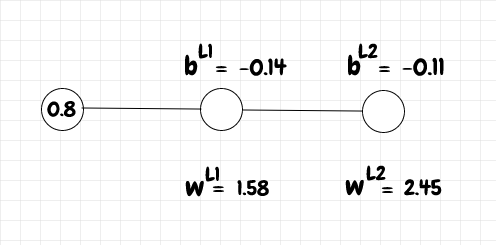
We ran an input of 0.8 through the network, then backpropagated using 1 as the target value, with a learning rate of 0.1. We used sigmoid as the activation function and the quadratic cost function to compare the actual output from the network with the desired output.
The code below uses PyTorch to do the same thing:
import torch
import torch.nn as nn
import torch.optim as optim


class Net(nn.Module):
    def __init__(self):
        super(Net, self).__init__()
        self.hidden_layer = nn.Linear(1, 1)
        self.hidden_layer.weight = torch.nn.Parameter(torch.tensor([[1.58]]))
        self.hidden_layer.bias = torch.nn.Parameter(torch.tensor([-0.14]))

        self.output_layer = nn.Linear(1, 1)
        self.output_layer.weight = torch.nn.Parameter(torch.tensor([[2.45]]))
        self.output_layer.bias = torch.nn.Parameter(torch.tensor([-0.11]))

    def forward(self, x):
        x = torch.sigmoid(self.hidden_layer(x))
        x = torch.sigmoid(self.output_layer(x))
        return x


net = Net()
print(f"network topology: {net}")

print(f"w_l1 = {round(net.hidden_layer.weight.item(), 4)}")
print(f"b_l1 = {round(net.hidden_layer.bias.item(), 4)}")
print(f"w_l2 = {round(net.output_layer.weight.item(), 4)}")
print(f"b_l2 = {round(net.output_layer.bias.item(), 4)}")

# run input data forward through network
input_data = torch.tensor([0.8])
output = net(input_data)
print(f"a_l2 = {round(output.item(), 4)}")

# backpropagate gradient
target = torch.tensor([1.])
criterion = nn.MSELoss()
loss = criterion(output, target)
net.zero_grad()
loss.backward()

# update weights and biases
optimizer = optim.SGD(net.parameters(), lr=0.1)
optimizer.step()

print(f"updated_w_l1 = {round(net.hidden_layer.weight.item(), 4)}")
print(f"updated_b_l1 = {round(net.hidden_layer.bias.item(), 4)}")
print(f"updated_w_l2 = {round(net.output_layer.weight.item(), 4)}")
print(f"updated_b_l2 = {round(net.output_layer.bias.item(), 4)}")

output = net(input_data)
print(f"updated_a_l2 = {round(output.item(), 4)}")
Some notes on this code:
nn.Linearis used for fully connected, or dense, layers. For this simple case, we have a single input and a single output for each layer.- The
forwardmethod is called when we pass the input into the network withoutput = net(input_data). - By default, PyTorch sets up random weights and biases. However, here we initialize them directly since we want the results to match our manual calculation (shown later in the article).
- In PyTorch,
tensoris analogous toarrayin numpy. criterion = nn.MSELoss()sets up the quadratic cost function - though it’s called the mean squared error loss function in PyTorch.loss = criterion(output, target)calculates the cost, also known as the loss.- Next we use
net.zero_grad()to reset the gradient to zero (otherwise the backpropagation is cumulative). It isn’t strictly necessary here, but it’s good to keep this in mind when running backpropagation in a loop. loss.backward()computes the gradient, i.e. the derivative of the cost with respect to all of the weights and biases.- Finally we use this gradient to update the weights and biases in the network using the
SGD(stochastic gradient descent) optimizer, with a learning rate of 0.1.
The results are below:
C:\Dev\python\pytorch>python backprop_pytorch.py
network topology: Net(
  (hidden_layer): Linear(in_features=1, out_features=1, bias=True)
  (output_layer): Linear(in_features=1, out_features=1, bias=True)
)
w_l1 = 1.58
b_l1 = -0.14
w_l2 = 2.45
b_l2 = -0.11
a_l2 = 0.8506
updated_w_l1 = 1.5814
updated_b_l1 = -0.1383
updated_w_l2 = 2.4529
updated_b_l2 = -0.1062
updated_a_l2 = 0.8515
We print out the network topology as well as the weights, biases, and output, both before and after the backpropagation step.
Below, let’s replicate this calculation with plain Python. This calculation is almost the same as the one we saw in the neural networks primer. The only difference is that PyTorch’s MSELoss function doesn’t have the extra division by 2, so in the code below, I’ve adjusted dc_da_l2 = 2 * (a_l2-1) to match what PyTorch does:


import numpy as np


def sigmoid(z_value):
    return 1.0/(1.0+np.exp(-z_value))


def z(w, a, b):
    return w * a + b


def sigmoid_prime(z_value):
    return sigmoid(z_value)*(1-sigmoid(z_value))


def dc_db(z_value, dc_da):
    return sigmoid_prime(z_value) * dc_da


def dc_dw(a_prev, dc_db_value):
    return a_prev * dc_db_value


def dc_da_prev(w, dc_db_value):
    return w * dc_db_value


a_l0 = 0.8
w_l1 = 1.58
b_l1 = -0.14
print(f"w_l1 = {round(w_l1, 4)}")
print(f"b_l1 = {round(b_l1, 4)}")

z_l1 = z(w_l1, a_l0, b_l1)
a_l1 = sigmoid(z_l1)

w_l2 = 2.45
b_l2 = -0.11
print(f"w_l2 = {round(w_l2, 4)}")
print(f"b_l2 = {round(b_l2, 4)}")

z_l2 = z(w_l2, a_l1, b_l2)
a_l2 = sigmoid(z_l2)
print(f"a_l2 = {round(a_l2, 4)}")

dc_da_l2 = 2 * (a_l2-1)
dc_db_l2 = dc_db(z_l2, dc_da_l2)
dc_dw_l2 = dc_dw(a_l1, dc_db_l2)
dc_da_l1 = dc_da_prev(w_l2, dc_db_l2)

step_size = 0.1
updated_b_l2 = b_l2 - dc_db_l2 * step_size
updated_w_l2 = w_l2 - dc_dw_l2 * step_size

dc_db_l1 = dc_db(z_l1, dc_da_l1)
dc_dw_l1 = dc_dw(a_l0, dc_db_l1)

updated_b_l1 = b_l1 - dc_db_l1 * step_size
updated_w_l1 = w_l1 - dc_dw_l1 * step_size

print(f"updated_w_l1 = {round(updated_w_l1, 4)}")
print(f"updated_b_l1 = {round(updated_b_l1, 4)}")

print(f"updated_w_l2 = {round(updated_w_l2, 4)}")
print(f"updated_b_l2 = {round(updated_b_l2, 4)}")

updated_z_l1 = z(updated_w_l1, a_l0, updated_b_l1)
updated_a_l1 = sigmoid(updated_z_l1)
updated_z_l2 = z(updated_w_l2, updated_a_l1, updated_b_l2)
updated_a_l2 = sigmoid(updated_z_l2)
print(f"updated_a_l2 = {round(updated_a_l2, 4)}")
Here are the results:
C:\Dev\python\pytorch>python backprop_manual_calculation.py
w_l1 = 1.58
b_l1 = -0.14
w_l2 = 2.45
b_l2 = -0.11
a_l2 = 0.8506
updated_w_l1 = 1.5814
updated_b_l1 = -0.1383
updated_w_l2 = 2.4529
updated_b_l2 = -0.1062
updated_a_l2 = 0.8515
We can see that the results match the ones from the PyTorch network! In the next article, we’ll use PyTorch to recognize digits from the MNIST database.
The code is available on github: https://github.com/nestedsoftware/pytorch
[출처] https://nestedsoftware.com/2019/08/15/pytorch-hello-world-37mo.156165.html
광고 클릭에서 발생하는 수익금은 모두 웹사이트 서버의 유지 및 관리, 그리고 기술 콘텐츠 향상을 위해 쓰여집니다.
