
- 전체
- HTML
- Web Design (웹디자인)
- XE 응용 개발
- wordpress plugin dev
- Javascript & JavaScript Application
- MEAN Stack : full stack javascript
- angular js & ionic framework
- bootstrap
- WebGL, Three.js and Babylon.js
- restful api design
- mobile web
- node.js 응용
- Cloud Service 응용
- 웹 어셈블리 개발 [WASM, WebAssembly]
- 마이크로서비스, MSA (microservice architecture)
- WebGL / WebGPU
- next.js 개발
- micro frontend (마이크로프론트앤드)
- 전자상거래/쇼핑몰
- 서버 클라우드 (aws, azure, google)
A pattern language for microservices
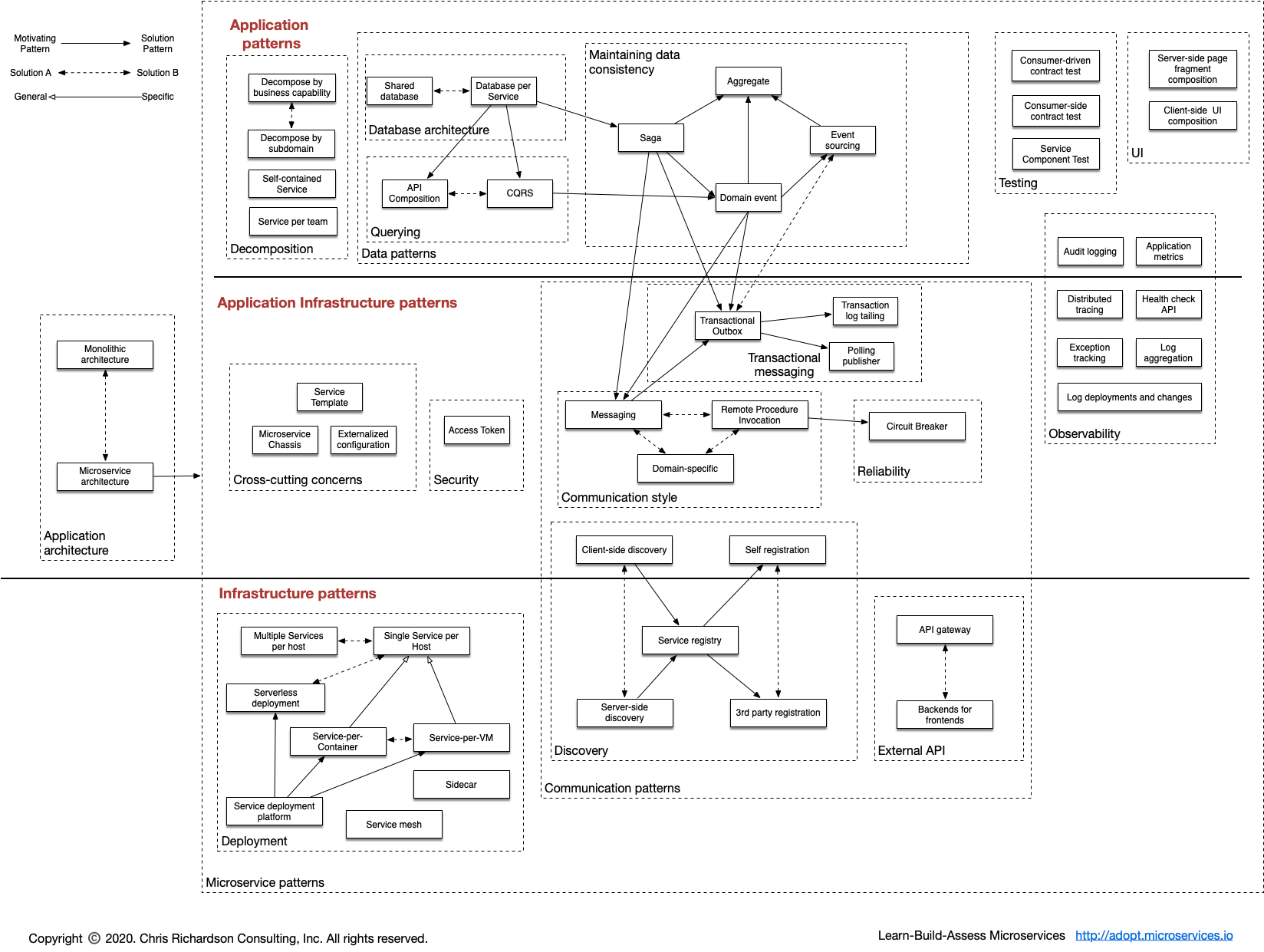
Application architecture patterns
Which architecture should you choose for an application?
- Monolithic architecture - architect an application as a single deployable unit
- Microservice architecture - architect an application as a collection of loosely coupled, services
Decomposition
How to decompose an application into services?
- Decompose by business capability - define services corresponding to business capabilities
- Decompose by subdomain - define services corresponding to DDD subdomains
- Self-contained Service - design services to handle synchronous requests without waiting for other services to respondnew
- Service per teamnew
Refactoring to microservicesnew
Data management
How to maintain data consistency and implement queries?
- Database per Service - each service has its own private database
- Shared database - services share a database
- Saga - use sagas, which a sequences of local transactions, to maintain data consistency across services
- API Composition - implement queries by invoking the services that own the data and performing an in-memory join
- CQRS - implement queries by maintaining one or more materialized views that can be efficiently queried
- Domain event - publish an event whenever data changes
- Event sourcing - persist aggregates as a sequence of events
Transactional messaging
How to publish messages as part of a database transaction?
Testing
How to make testing easier?
- Consumer-driven contract test - a test suite for a service that is written by the developers of another service that consumes it
- Consumer-side contract test - a test suite for a service client (e.g. another service) that verifies that it can communicate with the service
- Service component sest - a test suite that tests a service in isolation using test doubles for any services that it invokes
Deployment patterns
How to deploy an application’s services?
- Multiple service instances per host - deploy multiple service instances on a single host
- Service instance per host - deploy each service instance in its own host
- Service instance per VM - deploy each service instance in its VM
- Service instance per Container - deploy each service instance in its container
- Serverless deployment - deploy a service using serverless deployment platform
- Service deployment platform - deploy services using a highly automated deployment platform that provides a service abstraction
Cross cutting concerns
How to handle cross cutting concerns?
- Microservice chassis - a framework that handles cross-cutting concerns and simplifies the development of services
- Externalized configuration - externalize all configuration such as database location and credentials
- Service Template - a template that implements standard cross cutting concerns and is intended to be copied by a developer in order to quickly start developing a new service
Communication patterns
Style
Which communication mechanisms do services use to communicate with each other and their external clients?
- Remote Procedure Invocation - use an RPI-based protocol for inter-service communication
- Messaging - use asynchronous messaging for inter-service communication
- Domain-specific protocol - use a domain-specific protocol
- Idempotent Consumer - ensure that message consumers can cope with being invoked multiple times with the same message
External API
How do external clients communicate with the services?
- API gateway - a service that provides each client with unified interface to services
- Backend for front-end - a separate API gateway for each kind of client
Service discovery
How does the client of an RPI-based service discover the network location of a service instance?
- Client-side discovery - client queries a service registry to discover the locations of service instances
- Server-side discovery - router queries a service registry to discover the locations of service instances
- Service registry - a database of service instance locations
- Self registration - service instance registers itself with the service registry
- 3rd party registration - a 3rd party registers a service instance with the service registry
Reliability
How to prevent a network or service failure from cascading to other services?


- Circuit Breaker - invoke a remote service via a proxy that fails immediately when the failure rate of the remote call exceeds a threshold
Security
How to communicate the identity of the requestor to the services that handle the request?
- Access Token - a token that securely stores information about user that is exchanged between services
Observability
How to understand the behavior of an application and troubleshoot problems?
- Log aggregation - aggregate application logs
- Application metrics - instrument a service’s code to gather statistics about operations
- Audit logging - record user activity in a database
-
Distributed tracing - instrument services with code that assigns each external request an unique identifier that is passed between services. Record information (e.g. start time, end time) about the work (e.g. service requests) performed when handling the external request in a centralized service
-
Exception tracking - report all exceptions to a centralized exception tracking service that aggregates and tracks exceptions and notifies developers.
-
Health check API - service API (e.g. HTTP endpoint) that returns the health of the service and is intended to be pinged, for example, by a monitoring service
- Log deployments and changes
UI patterns
How to implement a UI screen or page that displays data from multiple services?
-
Server-side page fragment composition - build a webpage on the server by composing HTML fragments generated by multiple, business capability/subdomain-specific web applications
-
Client-side UI composition - Build a UI on the client by composing UI fragments rendered by multiple, business capability/subdomain-specific UI components
[출처] https://microservices.io/patterns/index.html
광고 클릭에서 발생하는 수익금은 모두 웹사이트 서버의 유지 및 관리, 그리고 기술 콘텐츠 향상을 위해 쓰여집니다.
댓글 0
| 번호 | 제목 | 글쓴이 | 날짜 | 조회 수 |
|---|---|---|---|---|
| 9 |
테이블 태그 셀 합치기 그리고, 테이블 안 테이블
 | 졸리운_곰 | 2019.03.23 | 566 |
| 8 | 테이블 컬럼 너비 고정 : Fixed Table Cell Width | 졸리운_곰 | 2019.03.21 | 767 |
| 7 | 포지션 css - position (static, relative, absolute, fixed 차이) | 졸리운_곰 | 2019.03.16 | 496 |
| 6 |
DIV 태그를 이용하여 레이아웃 만들기
| 졸리운_곰 | 2019.02.06 | 806 |
| 5 | HTML DIV tag: 세 개의 DIV영역을 가로로 나란히 놓는 방법 - 테이블과 비교 | 졸리운_곰 | 2019.02.04 | 589 |
| 4 |
카드형 디자인/갤러리/리스트 코딩하기.
| 졸리운_곰 | 2018.09.06 | 481 |
| 3 |
[HTML5] span과 div의 차이
| 졸리운_곰 | 2018.06.04 | 800 |
| 2 | HTML div 왼쪽, 오른쪽 배치 | 가을의곰 | 2017.06.10 | 493 |
| 1 |
XPath 이야기
| 졸리운_곰 | 2017.03.20 | 591 |