| |
# -*- coding: utf-8 -*- |
| |
""" |
| |
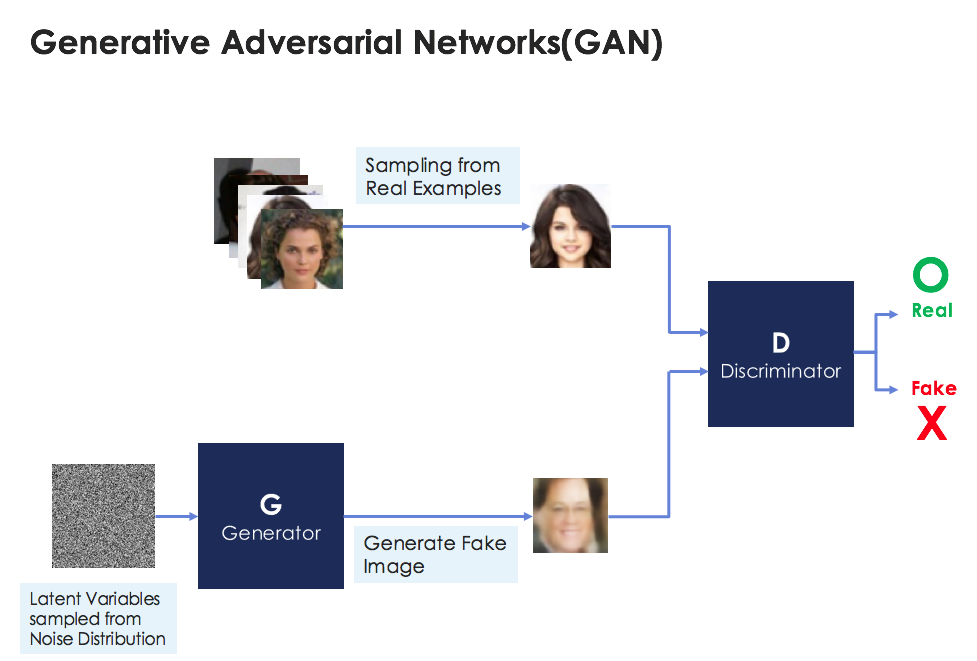
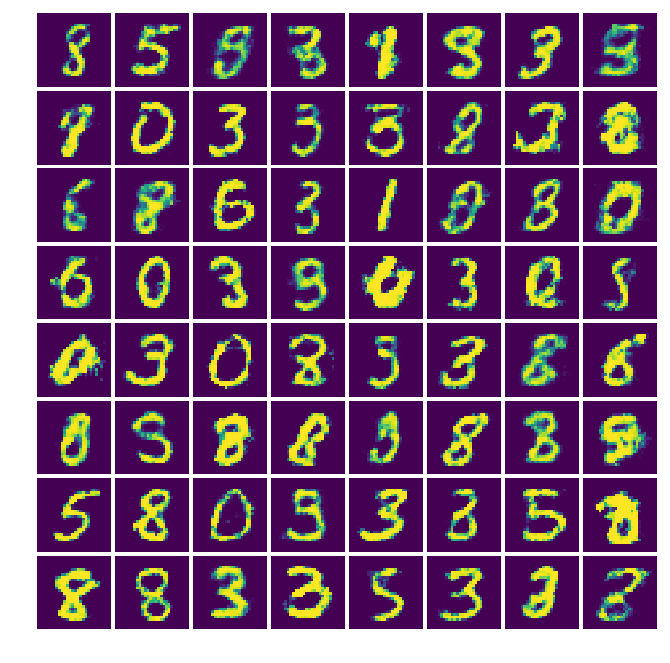
GAN(Generative Adversarial Networks)을 이용한 MNIST 데이터 생성 |
| |
|
| |
Reference : https://github.com/TengdaHan/GAN-TensorFlow |
| |
|
| |
Author : solaris33 |
| |
Project URL : http://solarisailab.com/archives/2482 |
| |
""" |
| |
|
| |
import tensorflow as tf |
| |
import numpy as np |
| |
import matplotlib.pyplot as plt |
| |
import matplotlib.gridspec as gridspec |
| |
import os |
| |
|
| |
# MNIST 데이터를 불러옵니다. |
| |
from tensorflow.examples.tutorials.mnist import input_data |
| |
mnist = input_data.read_data_sets("./mnist/data/", one_hot=True) |
| |
|
| |
# 생성된 MNIST 이미지를 8x8 Grid로 보여주는 plot 함수를 정의합니다. |
| |
def plot(samples): |
| |
fig = plt.figure(figsize=(8, 8)) |
| |
gs = gridspec.GridSpec(8, 8) |
| |
gs.update(wspace=0.05, hspace=0.05) |
| |
|
| |
for i, sample in enumerate(samples): |
| |
ax = plt.subplot(gs[i]) |
| |
plt.axis('off') |
| |
plt.imshow(sample.reshape(28, 28)) |
| |
return fig |
| |
|
| |
# 설정값들을 선언합니다. |
| |
num_epoch = 100000 |
| |
batch_size = 64 |
| |
num_input = 28 * 28 |
| |
num_latent_variable = 100 |
| |
num_hidden = 128 |
| |
learning_rate = 0.001 |
| |
|
| |
# 플레이스 홀더를 선언합니다. |
| |
X = tf.placeholder(tf.float32, [None, num_input]) # 인풋 이미지 |
| |
z = tf.placeholder(tf.float32, [None, num_latent_variable]) # 인풋 Latent Variable |
| |
|
| |
# Generator 변수들 설정 |
| |
# 100 -> 128 -> 784 |
| |
with tf.variable_scope('generator'): |
| |
# 히든 레이어 파라미터 |
| |
G_W1 = tf.Variable(tf.random_normal(shape=[num_latent_variable, num_hidden], stddev=5e-2)) |
| |
G_b1 = tf.Variable(tf.constant(0.1, shape=[num_hidden])) |
| |
# 아웃풋 레이어 파라미터 |
| |
G_W2 = tf.Variable(tf.random_normal(shape=[num_hidden, num_input], stddev=5e-2)) |
| |
G_b2 = tf.Variable(tf.constant(0.1, shape=[num_input])) |
| |
|
| |
# Discriminator 변수들 설정 |
| |
# 784 -> 128 -> 1 |
| |
with tf.variable_scope('discriminator'): |
| |
# 히든 레이어 파라미터 |
| |
D_W1 = tf.Variable(tf.random_normal(shape=[num_input, num_hidden], stddev=5e-2)) |
| |
D_b1 = tf.Variable(tf.constant(0.1, shape=[num_hidden])) |
| |
# 아웃풋 레이어 파라미터 |
| |
D_W2 = tf.Variable(tf.random_normal(shape=[num_hidden, 1], stddev=5e-2)) |
| |
D_b2 = tf.Variable(tf.constant(0.1, shape=[1])) |
| |
|
| |
# Generator를 생성하는 함수를 정의합니다. |
| |
# Inputs: |
| |
# X : 인풋 Latent Variable |
| |
# Output: |
| |
# generated_mnist_image : 생성된 MNIST 이미지 |
| |
def build_generator(X): |
| |
hidden_layer = tf.nn.relu((tf.matmul(X, G_W1) + G_b1)) |
| |
output_layer = tf.matmul(hidden_layer, G_W2) + G_b2 |
| |
generated_mnist_image = tf.nn.sigmoid(output_layer) |
| |
|
| |
return generated_mnist_image |
| |
|
| |
# Discriminator를 생성하는 함수를 정의합니다. |
| |
# Inputs: |
| |
# X : 인풋 이미지 |
| |
# Output: |
| |
# predicted_value : Discriminator가 판단한 True(1) or Fake(0) |
| |
# logits : sigmoid를 씌우기전의 출력값 |
| |
def build_discriminator(X): |
| |
hidden_layer = tf.nn.relu((tf.matmul(X, D_W1) + D_b1)) |
| |
logits = tf.matmul(hidden_layer, D_W2) + D_b2 |
| |
predicted_value = tf.nn.sigmoid(logits) |
| |
|
| |
return predicted_value, logits |
| |
|
| |
# 생성자(Generator)를 선언합니다. |
| |
G = build_generator(z) |
| |
|
| |
# 구분자(Discriminator)를 선언합니다. |
| |
D_real, D_real_logits = build_discriminator(X) # D(x) |
| |
D_fake, D_fake_logits = build_discriminator(G) # D(G(z)) |
| |
|
| |
# Discriminator의 손실 함수를 정의합니다. |
| |
d_loss_real = tf.reduce_mean(tf.nn.sigmoid_cross_entropy_with_logits(logits=D_real_logits, labels=tf.ones_like(D_real_logits))) # log(D(x)) |
| |
d_loss_fake = tf.reduce_mean(tf.nn.sigmoid_cross_entropy_with_logits(logits=D_fake_logits, labels=tf.zeros_like(D_fake_logits))) # log(1-D(G(z))) |
| |
d_loss = d_loss_real + d_loss_fake # log(D(x)) + log(1-D(G(z))) |
| |
|
| |
# Generator의 손실 함수를 정의합니다. |
| |
g_loss = tf.reduce_mean(tf.nn.sigmoid_cross_entropy_with_logits(logits=D_fake_logits, labels=tf.ones_like(D_fake_logits))) # log(D(G(z)) |
| |
|
| |
# 전체 파라미터를 Discriminator와 관련된 파라미터와 Generator와 관련된 파라미터로 나눕니다. |
| |
tvar = tf.trainable_variables() |
| |
dvar = [var for var in tvar if 'discriminator' in var.name] |
| |
gvar = [var for var in tvar if 'generator' in var.name] |
| |
|
| |
# Discriminator와 Generator의 Optimizer를 정의합니다. |
| |
d_train_step = tf.train.AdamOptimizer(learning_rate).minimize(d_loss, var_list=dvar) |
| |
g_train_step = tf.train.AdamOptimizer(learning_rate).minimize(g_loss, var_list=gvar) |
| |
|
| |
# 생성된 이미지들을 저장할 generated_outputs 폴더를 생성합니다. |
| |
num_img = 0 |
| |
if not os.path.exists('generated_output/'): |
| |
os.makedirs('generated_output/') |
| |
|
| |
with tf.Session() as sess: |
| |
# 변수들에 초기값을 할당합니다. |
| |
sess.run(tf.global_variables_initializer()) |
| |
|
| |
# num_epoch 횟수만큼 최적화를 수행합니다. |
| |
for i in range(num_epoch): |
| |
# MNIST 이미지를 batch_size만큼 불러옵니다. |
| |
batch_X, _ = mnist.train.next_batch(batch_size) |
| |
# Latent Variable의 인풋으로 사용할 noise를 Uniform Distribution에서 batch_size만큼 샘플링합니다. |
| |
batch_noise = np.random.uniform(-1., 1., [batch_size, 100]) |
| |
|
| |
# 500번 반복할때마다 생성된 이미지를 저장합니다. |
| |
if i % 500 == 0: |
| |
samples = sess.run(G, feed_dict={z: np.random.uniform(-1., 1., [64, 100])}) |
| |
fig = plot(samples) |
| |
plt.savefig('generated_output/%s.png' % str(num_img).zfill(3), bbox_inches='tight') |
| |
num_img += 1 |
| |
plt.close(fig) |
| |
|
| |
# Discriminator 최적화를 수행하고 Discriminator의 손실함수를 return합니다. |
| |
_, d_loss_print = sess.run([d_train_step, d_loss], feed_dict={X: batch_X, z: batch_noise}) |
| |
|
| |
# Generator 최적화를 수행하고 Generator 손실함수를 return합니다. |
| |
_, g_loss_print = sess.run([g_train_step, g_loss], feed_dict={z: batch_noise}) |
| |
|
| |
# 100번 반복할때마다 Discriminator의 손실함수와 Generator 손실함수를 출력합니다. |
| |
if i % 100 == 0: |
| |
print('반복(Epoch): %d, Generator 손실함수(g_loss): %f, Discriminator 손실함수(d_loss): %f' % (i, g_loss_print, d_loss_print)) |